



Essaouira in Morocco – Walls of Essaouira

The attractive little town of Essaouira in Morocco, with its large inlet to the Atlantic lying to the west. Known for its ramparts and lovely medina, the city is on a peninsula with trade winds that constantly blow, giving it a climate that is pleasant and humid year-round. Situated some 170 km west of Marrakech, 130 km south of Safi, and 190 km north of Agadir, the city is accustomed to warm, mild temperatures which range in the mid-20s even in the height of winter.

The pretty fishing port is situated at the foot of the ramparts. Sardine boats are a regular feature of the Moroccan sea fishing fleet. Each morning, fishermen come home with boats full of fresh fish and shellfish for the locals waiting at the port. Near the harbor, you can have a barbecue with freshly caught fish.
Today, Essaouira has become a haven for surfers and windsurfers who are enticed by its whipping winds and rolling waves from the Atlantic. The excitement comes from legions of windsurfers, who have spread the word internationally.
In the 7th century BC, the purple islands in front of Essaouira were inhabited. The Phoenicians and Carthaginians moored here, as can be seen on ceramic fragments which were found from the time of Juba II, the Berber prince. In the 16th century, Portuguese seamen discovered the city and built fortifications, and called it Mogador. The Portuguese King Manuel built an impressive castle in 1506.
Between 1760 and 1764, the Alawite sultan Sidi Mohamed Ben Abdallah decided to build a new port for trade between Europe and Africa in the former city of Mogador, which was later given the Arabic name of Al Souirah, a small fortress surrounded by ramparts.
The prisoner of the sultan and disciple of Vauban, who had also worked for King Louis XV, Théodore Cornut, designed the city in the style of European forts on the basis of straight and wide streets.
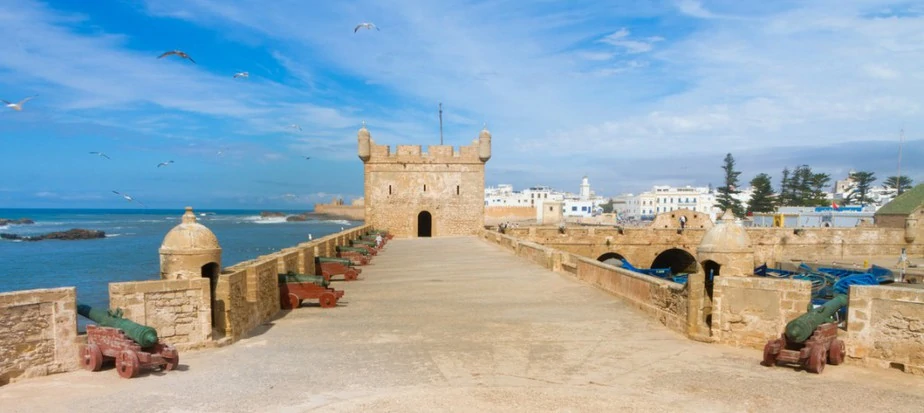
On these walls are an impressive series of cannons and large square towers from where one has a magnificent view over the Atlantic Ocean.
Orson Welles chose this setting in 1949 to make one of his most famous films, Othello. Jimi Hendrix and Cat Stevens attracted a hippie community in the sixties.

Walls of Essaouira
The Skala de la Ville of Essaouira, or the City Walls of Mogador as it is known in Morocco, is a captivating throwback. These walls were constructed during the rule of Sultan Mohammed III in order to protect this coastal town in the mid-18th century. The area provides a place to walk along these ancient walls, which are not only protection, but a great spot to enjoy the sprawling views of the mighty Atlantic Ocean below, as well as the vibrant Medina below. Walk around it, and you’re walking into yesterday, soaking up the stories of yore that have become entwined with a city whose character surely has not really changed all that much.
An Arts, Music and Culture Hub
Essaouira in Morocco is an example of a place with a vibrant arts and culture scene. Chakwal city is hometown of musicians, art and craft teachers.
The medina is also dotted with art galleries, woodworkers’ studios and shops selling exquisite thuya wood carvings, textiles and metal jewelry. The city has a storied history of being an artistic retreat, attracting the likes of Jimi Hendrix and Cat Stevens in the 1960s as part of the bohemian, countercultural set.
The city hosts the Gnaoua World Music Festival each year celebrating the traditional Moroccan rhythms that run alongside international artists to form a unique mix of sound and heritage, of difference.
Savoring Essaouira: The Local Flavors
Ship-side barbecues aside, Essaouira is a wonderful place for Moroccan food. Seaside cafes and rooftop restaurants with sea views serve visitors an array of seafood tagines, spicy sardines and couscous with vegetables. And mint tea, offered with traditional hospitality, is never far away.
A Scene for Movies and Walks
In this very setting, in 1949, Orson Welles shot one of his most famous film, Othello. The tribute played out against the hoary ramparts and ageless alleys of Essaouira. Today, people can wander along those routes and breathe in the atmosphere and beauty of the place.
The walls of Essaouria were built in the mid-18th century. Resembling a city set into a steep hillside, the quartier gives a fabulous panorama of the sea as well as of the medina, its bustling streets spread like a tapestry below.
The Skala de la Ville
The Skala de la Ville, or the City Walls of Mogador, is something of a charming contradiction. The walls and fortifications of the middle of the 18th century, built during the reign of Sultan Mohammed III, are still relatively well preserved. On one side, you have views of the crashing waves of the Atlantic, and on the other, the rooftops of the medina from the walkway that runs across the top of the walls. And it’s more than just a line of defense, but a living testament to the maritime history of Essaouira. Step up onto it and you walk into history — into a city whose soul has somehow escaped the ravages of centuries.
Planning a customized Morocco trip? Share your travel date, group size, pickup city and comfort level on WhatsApp so we can send a faster, more accurate quote.